
What Is a Roadheader and How Does It Work?
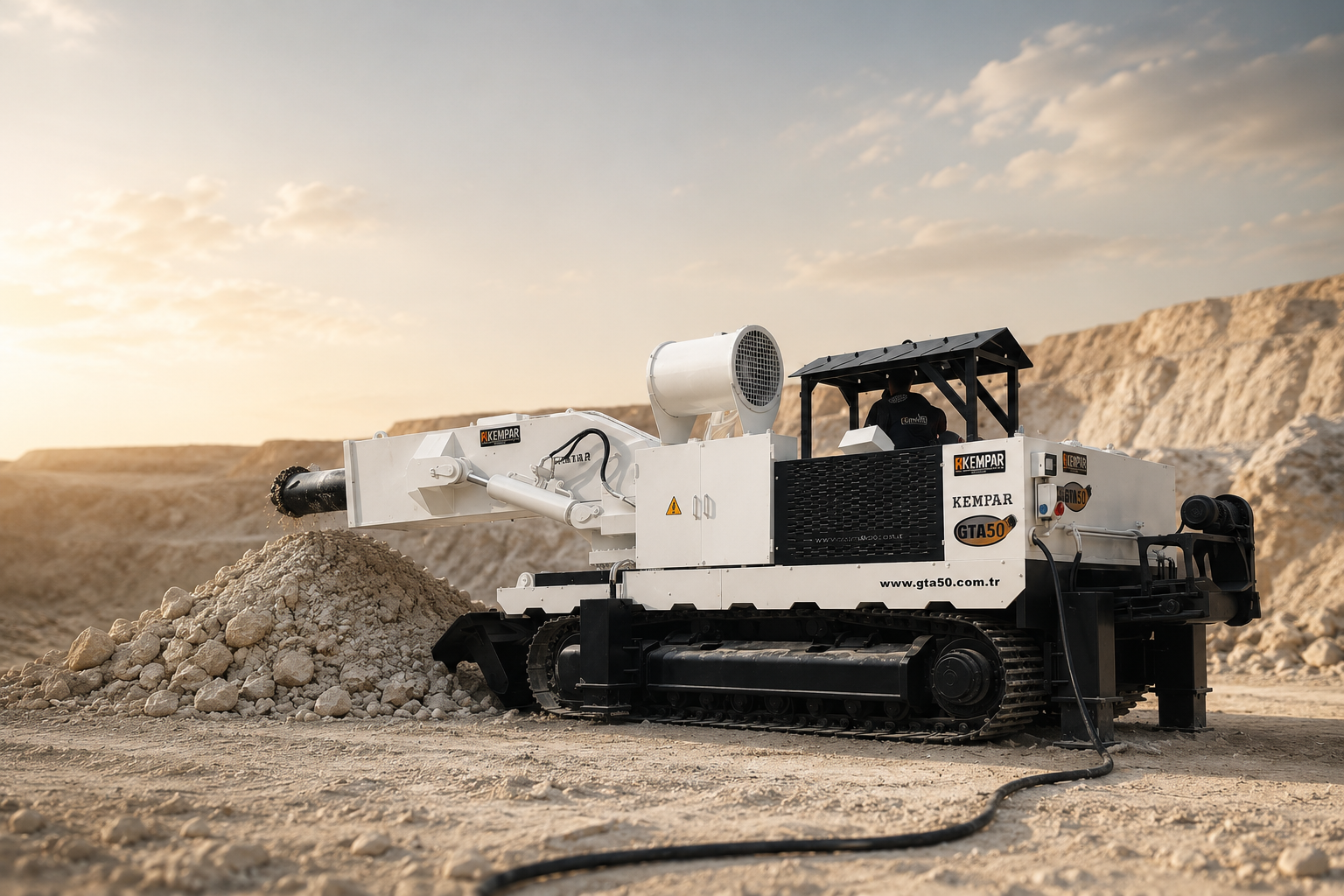
A roadheader is a crawler-mounted excavation machine with a boom-mounted cutting head that works the face in pieces. The operator steers the head across the face and builds the gallery or tunnel profile step by step. That is selective, or partial-face, mechanized excavation — not a full-face bore.
How does a roadheader work?
Tracks bring the machine up to the face. The cutter picks rock or mineral; a loading arrangement and conveyor move the spoil to the rear. Cutting, loading and advance sit on one unit.
The section is not opened as a finished circle in one pass. The profile is traced on the face. A TBM, by contrast, advances a full face fixed largely by cutter diameter and shield. That distinction is set out in roadheader vs TBM.
Main components of a roadheader
Boom-type machines repeat the same groups. GTA50 data sheets publish the matching figures: working weight, crawler weight, cutting-head and hydraulic motor ratings, control type, and cross-section.
- Cutting head and boom
- Crawler undercarriage
- Loading and material transfer
- Hydraulic power (GTA50 tables: variable-displacement load-sensing pump)
- Electric drive and controls (joystick; some models also manual)
Kilowatts and metres change by model. Read them on the model page.
How is a roadheader used in excavation?
In a gallery the usual job is to advance a production or service heading. In a tunnel the job is to form a designed civil or infrastructure section. In both cases the machine sweeps the required profile on the face. That sweep is useful when the geometry changes, when a side heading is needed, or when the outline is irregular. A long heading of fixed diameter is a different discussion — that is where full-face machines are weighed.
A roadheader does not automatically replace blasting. Ground support and the work programme may still require explosives or a mixed method. That is a site decision.
Where are roadheaders used?
The class appears in underground mining, gallery development and infrastructure tunnels. GTA50 product copy names salt, coal, soda, tunnel work, mining, infrastructure and natural storage. Those are catalogue contexts, not a certificate that the same machine fits every formation.
What should be considered when selecting a roadheader?
A catalogue name is not a specification. Section geometry, ground, ventilation and logistics, support, power supply and the intended advance have to be read together. The same phrase “roadheader machine” covers very different weights and sections.
GTA50, based in Nevşehir, publishes roadheader machines from 10T to 100T. Two published points show the scale: the compact 10T is listed at 10,000 KG working weight and a 2.50 – 2.50 m section for salt mines, coal mines and tunnel applications; the 30T is listed at 30,000 KG and 5.00 × 5.00 m for salt and coal mine operations. 12T, 18T, 50T, 80T and 100T use the same table language. Selection is those figures plus site conditions.
To compare published ratings, open the GTA50 roadheader machines pages or write via contact.