
What to Consider When Choosing a Roadheader
Choosing a roadheader is not finished when a tonnage badge is picked. The decision turns on the opening the job defines, the rock mass, whether the published machine body can pass the route and work in that heading, the two catalog motor ratings, and how those ratings will be supplied and maintained. The badge does not replace those questions.
This guide shows how to read the rows whose name and unit are stated on the GTA50 product pages: working weight, body length, width and height, cutting-head electric motor, and hydraulic-system electric motor. It does not assign a model to a formation. The catalog does not print advance rate, cutting force or price, and this page does not invent them. What the machine class is, is covered in what a roadheader is. This page does not repeat that definition.
Which criteria matter when choosing a roadheader?
Selection is read from four sources, not from one catalog cell. First is the job geometry: the height, width, curves and assembly chamber written by the project. Second is the rock mass: strength, discontinuities, abrasivity and water. Third is the published machine: length, width, height and working weight. Fourth is published electrical power: the cutter-head motor and the hydraulic-system motor, not added together.
They stay separate because they describe different things. Geometry describes the space the machine must enter. The rock mass describes the resistance at the face. Body size and weight describe haulage and the room inside the heading. Motor ratings are electrical power in the catalog. They are not a promise of advance. Substituting one for another is where selection usually fails.
The order is fixed. Write the project geometry and the geotechnical report first. Then set the published body and weight rows beside that limit. Read the kilowatts only after that, together with the supply the site can provide. Price, stock and lead time are outside this article.
The reading to avoid is “the next tonnage is the next job.” The catalog rows do not climb one ladder. The weight and motor sections below show that with published figures.
How do rock properties change the choice?
Uniaxial compressive strength (UCS) is the stress at which a laboratory specimen fails in one direction. It indicates the resistance the cutting system will meet. It does not select a machine. Two rock masses with the same UCS can behave differently at the face once jointing, bedding and water are included.
Discontinuities — joints, faults, bedding planes — change how the mass breaks. A closely jointed mass can come away more easily than the intact specimen strength suggests. A massive mass tracks that specimen value more closely. Aperture and infill tell you about water and about blocks. A report that contains only one UCS figure is incomplete for selection.
Abrasivity is a separate axis from strength. A quartz-rich rock can consume picks quickly even when compressive strength is moderate. Pick use, the time spent changing picks, and the pick inventory sit here. Abrasivity is often reported with a laboratory index such as Cerchar. A GTA50 model row does not carry that index. A model name is not a rock class.
Groundwater affects face stability, floor conditions and the limits of electrical equipment. A geotechnical report is supposed to hold strength, discontinuities, abrasivity, water and excavation geometry together. Marking a model before that report exists is a decision made on missing data.
The misread is to treat UCS as the only input. Strength without joints, water and abrasivity does not set a cutting pattern. Pick consumption then falls outside the quotation.
Is working weight enough on its own?
The tonnage in the model name is the published working weight. The 10T row is 10,000 KG. The 100T row is 100,000 KG. That mass is read for stability on the floor, the haulage limit, crane or truck capacity, and how much mass sits at the face.
It is not enough on its own. A heavier row is not published as a higher advance rate. Advance rate is not on the product pages. The weight column and the motor columns do not move together. The 30T hydraulic motor is published at 130 kW. The 80T hydraulic motor is published at 110 kW. The 80T and the 100T cutter motors are both 250 kW, while the working weights are 80,000 KG and 100,000 KG and the hydraulic motors are 110 kW and 200 kW. As the badge grows, both power ratings do not grow with it.
Read weight as a stability and transport question. Do not derive an excavation rate from the kilograms. The misread is to treat the next tonnage as the next performance step. The result is hauling a body the job does not need and never reading the published power columns.
How should cutter-head motor power be read?
The kilowatt (kW) is a unit of power. The kilonewton (kN) is a unit of force. The cutter-head cell is the published power of the cutter-head electric motor. The hydraulic-system cell is the published power of a separate electric motor. They do not describe the same job, and they are not added.
The sum of the two power ratings is not a cutting force. Turning power into force needs speed, torque and pick load, and the catalog does not print those. The product pages do not print a torque curve either. A kW figure is therefore not converted into “this force in this rock.” The same kilowatts at a different speed and pick load are not the same result. The catalog does not print that curve, so this guide does not invent one.
Read the ratings as follows. The cutter-head motor is the catalog power at the cutter drive. The hydraulic motor is the catalog power of the hydraulic work. Set both beside the electrical load the site can supply and the power the cable can carry. Supply and ventilation are project data. The catalog does not contain a site power calculation, and neither does this page.
Three readings should be refused. Adding the ratings into a hidden force. Treating a higher kW figure as an advance rate the catalog does not print. Stacking the hydraulic motor on the cutter motor and calling the stack a cutting capacity. The 50T row shows the split in numbers: cutter head 160 kW, hydraulic-system motor 110 kW. Those two figures stay apart.
Why do body dimensions and working room matter?
Excavation geometry is the void the job will open. Height, width, curve radius, changes of section and the assembly chamber are written by the project team. A boom-type machine does not open that profile as a full circle in one pass. The operator sweeps the cutter. How that differs from a TBM is set out in roadheader vs TBM. It is not repeated here. The selection question on this page is whether the body fits the void and the route, not which machine class the job belongs to.
Length, width and height on a GTA50 product page are the published dimensions of the machine body. They are not the profile the job will open. The three rows are read separately. In a tight heading the limit is often the clearance around the body, the room to turn and the room to reverse. The catalog does not state a rule that a larger job requires a larger body.
Published examples show a transport difference. They do not rank excavation capacity. The 10T body is 6.00 meters long, 1.20 meters wide and 1.65 meters high. The 80T and the 100T bodies are 12.60 meters long. The 100T body is 3.30 meters wide and 3.35 meters high. A length of 6.00 meters and a length of 12.60 meters do not have to pass the same shaft, ramp or assembly chamber. Working weight is not considered apart from those three dimensions.
The project writes the required excavation height and width, the narrowest passage and the assembly chamber. The three published body dimensions are compared with that clearance. They are not treated as the opening itself. The misread is to take body width as the excavation width. The result is a machine intended to sweep a profile it cannot enter.
How should maintenance, energy and operating cost be judged?
Purchase price is the first line of what the machine will cost on site. Total cost of ownership counts the rest. The catalog does not print those lines as numbers, and this guide does not invent them. It can say which item depends on which evidence.
- Productive time: the share of the shift spent cutting, changing picks, in fault and waiting. Advance rate is not in the catalog, so time is not invented from it.
- Pick consumption: driven more by abrasivity and the cutting pattern than by strength alone. A model name does not state that consumption.
- Energy: the published kilowatts of the two motors, limited by what the supply and the cable can carry. The kilowatts are not added and turned into a force.
- Maintenance and parts: the invoice, and when the part reaches the heading.
- Stops: oil, picks and hoses can be planned. Searching for a fault cannot.
- The operator: the same machine on the same face cuts for a different time in different hands. Training does not replace tonnage, and it is what keeps a published tonnage from being used badly.
The misread is to treat the quotation price as the whole cost. The sum is not closed until picks, energy, stops and training are written down. Those items move with the rock, the shift and site power. The table shows which machine row the sum should start from. It does not deliver the sum.
What are the operational risks of a poor choice?
A body that cannot enter the heading never reaches the power printed in the catalog. An arrangement that cannot meet the opening the job defined spends the shift on manoeuvres instead of cutting. An arrangement chosen without the abrasivity reading turns pick changes into unplanned stops. All three shorten productive time. Productive time is the hour the cutter is cutting, not the hour on the shift roster.
A body that is heavier than the access allows fails the other way. Manoeuvre in a narrow heading gets harder. The crane, the ramp and the assembly chamber may not accept the published mass and length. Installed power the job never uses still has to be supplied and maintained. A body length of 12.60 meters and a working weight of 100,000 KG stay on the table until a road and an assembly chamber exist.
Adding the power ratings is a separate risk. If the site supply is sized on a sum the catalog does not print, the cable and the ventilation are calculated from the wrong limit. Treating a sentence on the product page as a certificate does the same kind of damage. A job heading on that page is not the geotechnical report for a given seam.
Which published ratings should a model comparison use?
The range has seven models: 10T, 12T, 18T, 30T, 50T, 80T and 100T. The cells below are the specification rows on each product page, copied as published. Length, width and height belong to the machine body. The full range is on the roadheader machines catalog.
| Model | Working weight | Length | Width | Height | Cutting head electric motor | Hydraulic system electric motor |
|---|---|---|---|---|---|---|
| 10T | 10,000 KG | 6.00 meters | 1.20 meters | 1.65 meters | 55 kW | 55 kW |
| 12T | 12,000 KG | 6.50 meters | 1.85 meters | 1.80 meters | 75 kW | 75 kW |
| 18T | 18,000 KG | 7.00 meters | 2.30 meters | 1.90 meters | 75 kW | 90 kW |
| 30T | 30,000 KG | 8.70 meters | 2.70 meters | 2.10 meters | 90 kW | 130 kW |
| 50T | 50,000 KG | 10.60 meters | 3.00 meters | 2.50 meters | 160 kW | 110 kW |
| 80T | 80,000 KG | 12.60 meters | 3.30 meters | 3.15 meters | 250 kW | 110 kW |
| 100T | 100,000 KG | 12.60 meters | 3.30 meters | 3.35 meters | 250 kW | 200 kW |
The hydraulic system is written on every model as “Variable Displacement Load Sensing Pump”, so that row does not separate the models. Control is joystick on some models and joystick plus manual on others. It is not a power rating.
Compare these columns, not whether the badge is larger. By published working weight, the 100T is the heaviest model in the range. That sentence does not mean every site should ask for a 100T. The 30T hydraulic motor is 130 kW and the 50T hydraulic motor is 110 kW. Hydraulic power can fall while working weight and cutter-head power rise.
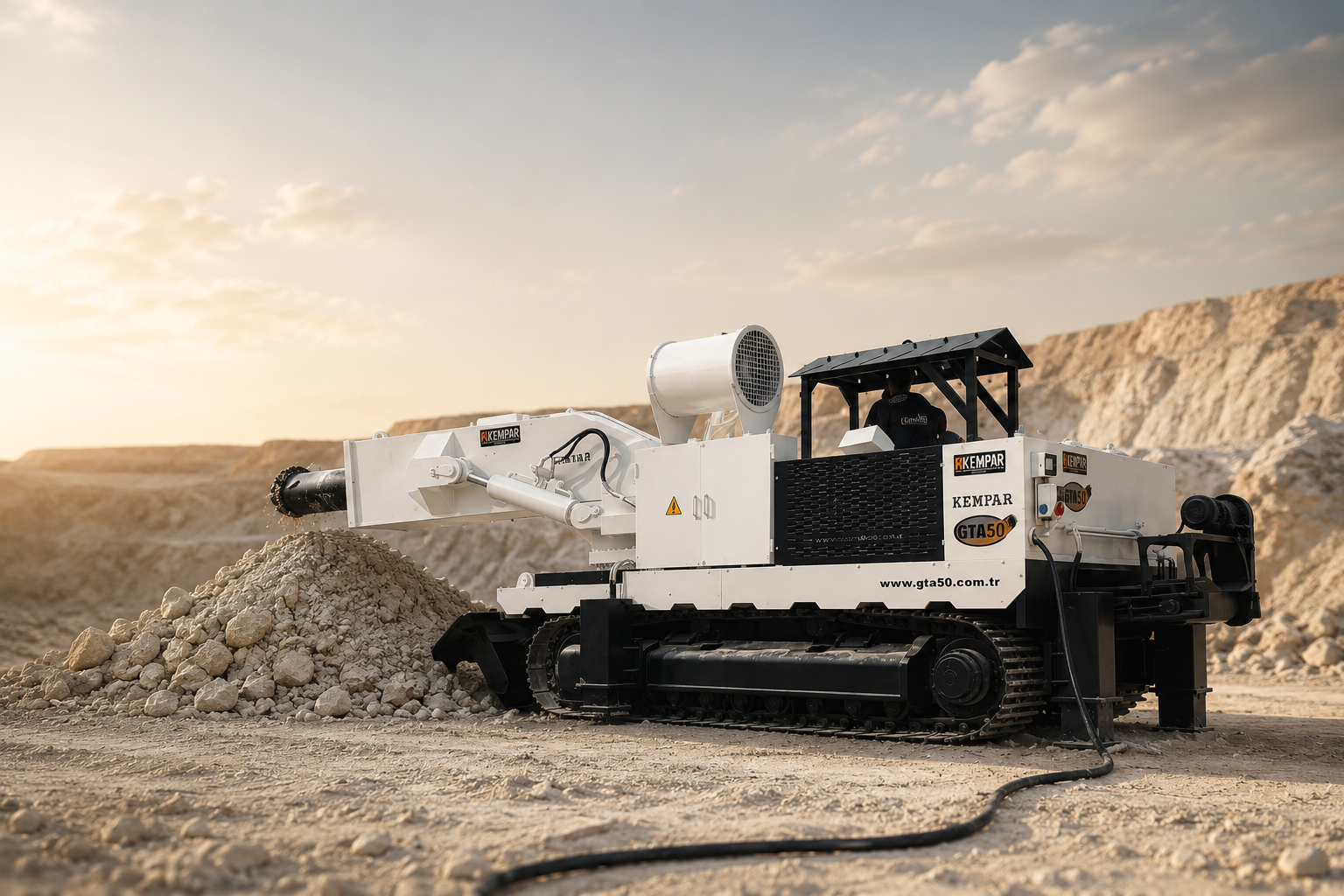
Technical decision matrix
The matrix is not a scorecard. It does not rank models. It separates questions answered by a catalog cell from questions that have to come from the project or the laboratory.
| Question | How to judge it | Where the evidence is |
|---|---|---|
| Strength, discontinuities, water | Cutting resistance and face behaviour | Geotechnical report. No UCS threshold on the model row. |
| Abrasivity | Pick use and stops | Laboratory index. A model name is not that class. |
| Required excavation height and width | The void the job will open | Project definition. Body size is not that void. |
| Body length, width and height | Haulage, turning and room in the heading | The three dimension rows on the product page |
| Working weight | Stability and transport | Working-weight row. Advance rate is not in that row. |
| Cutter-head motor | Published power at the cutter drive | kW row. It is not a cutting force in kN. |
| Hydraulic-system motor | Published power of the hydraulic work | Separate kW row. Not added to the cutter motor. |
| Energy, maintenance, training | Whether the operation can continue | Site supply and the maintenance plan. Price does not close it. |
A catalog-reading exercise
This is not a completed project, and it does not pick a winner. The figures are rows from the product pages.
Two neighbouring rows sit side by side. The 10T: 10,000 KG, body 6.00 meters, 1.20 meters and 1.65 meters, both motors 55 kW. The 12T: 12,000 KG, body 6.50 meters, 1.85 meters and 1.80 meters, both motors 75 kW. The exercise does not choose between them. Strength, abrasivity, water, the opening the job requires and the site supply are not in the exercise.
At the heavier end, the 30T row reads 30,000 KG and 90 kW / 130 kW. The 50T row reads 50,000 KG and 160 kW / 110 kW. Working weight and cutter-head power rise while the hydraulic power row falls from 130 kW to 110 kW. That is the point. The columns are read together. Tonnage order is not a decision by itself.
Checklist before a purchase meeting
- Does the geotechnical report carry discontinuities, water and abrasivity next to UCS?
- Are the required excavation height and width, the curves and the assembly chamber written down?
- Were body length, width and height compared with that clearance and with the route?
- Was working weight read separately for the crane, the ramp and the floor?
- Are the cutter-head motor and the hydraulic motor still separate powers, not added?
- Can site supply and ventilation carry those kilowatts?
- Are pick stock, maintenance and the parts route defined?
- Was cost read as price, picks, energy, stops and training together?
A “no” does not close the table. It stops anyone from marking a machine until that line is closed.
Questions that come up during selection
Does a higher working weight mean higher excavation performance?
No. Working weight is published for stability and haulage. The two motor ratings are other columns, and they do not have to grow with tonnage. Advance rate is not in the catalog.
Can a model be chosen from UCS alone?
No. UCS is a one-direction specimen value. Discontinuities, abrasivity and water produce a different face in the same mass. The catalog rows do not list a UCS threshold.
Is a motor kilowatt a cutting force?
No. kW is power and kN is force. The cutter-head motor and the hydraulic motor are two power ratings. Their sum does not calculate a cutting force. On the 50T row those ratings stand apart at 160 kW and 110 kW.
Are the body dimensions the excavation profile?
No. Length, width and height are the catalog dimensions of the machine body. The height and width the job will open are written by the project. The body is read to see whether it fits that void and the route.
What should a quotation request include before the table means anything?
Target excavation height and width, known strength and abrasivity, water, the clearance left for the body, the haulage limit and the site supply. If the first question is price, the columns cannot be compared. This article does not promise lead time or stock.
Continue the comparison from the catalog rows
Set your excavation geometry, geotechnical report and site limits beside the published GTA50 rows. A catalog row is not a suitability ruling. It is where the comparison starts.